
May 23, 2026
How to Reduce Inventory in Manufacturing Without Hurting Service Levels
Reducing inventory in manufacturing frees up cash—but cut the wrong stock and service collapses. Learn how supply chain leaders lower inventory while protecting fill rates.
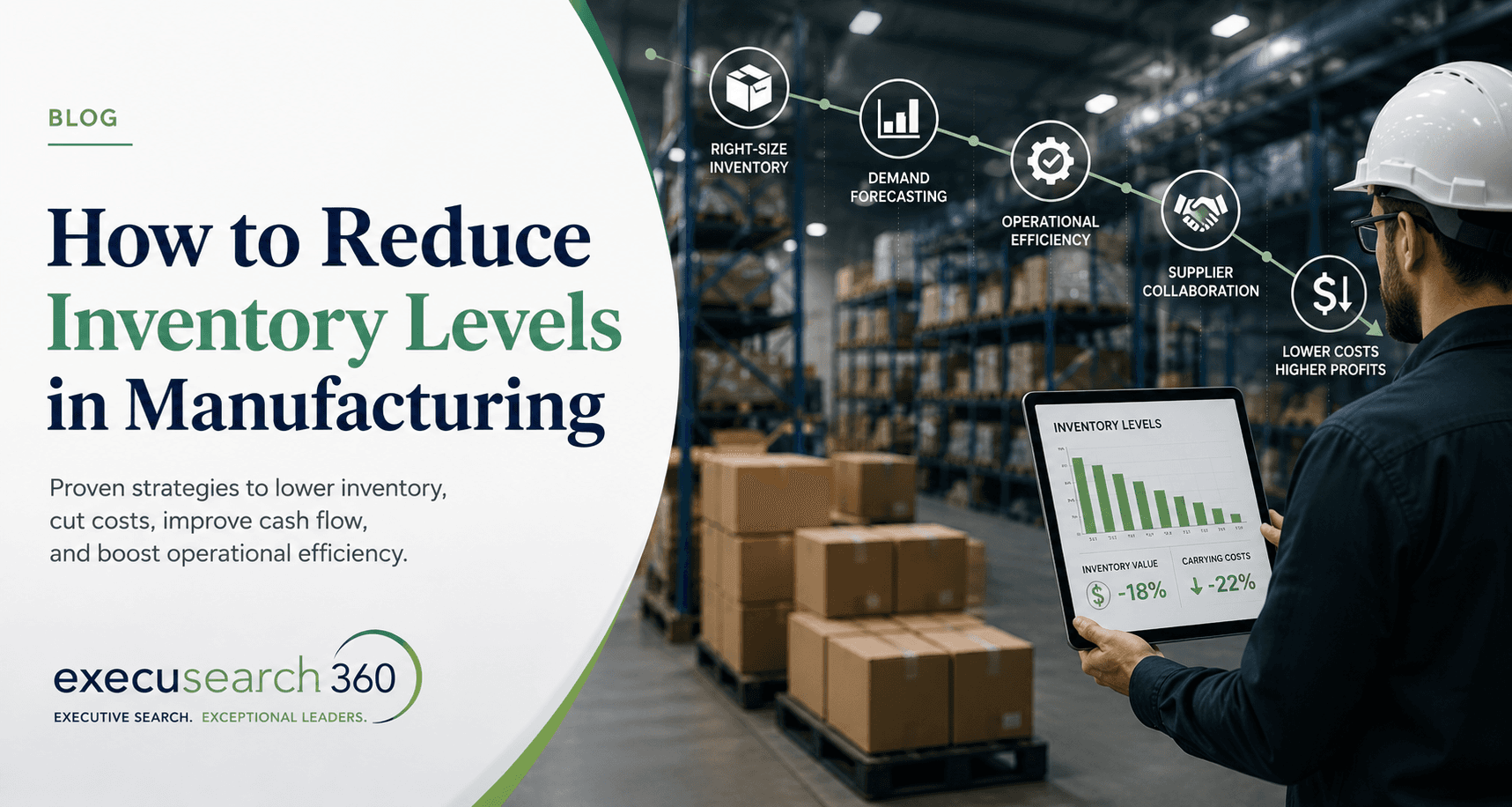
How to Reduce Inventory in Manufacturing Without Hurting Service Levels
Every supply chain leader has felt the pull from both directions. Finance wants the inventory number down because it is cash sitting idle on the balance sheet. Sales and operations want it up because nothing destroys customer trust faster than a stockout. The instinct, when the pressure to cut working capital arrives, is to issue a blanket directive: reduce inventory by 15%. That instinct is exactly how service levels collapse.
Reducing inventory in manufacturing is not about cutting stock across the board. It is about understanding which inventory is protecting your business and which is quietly costing you money, and then removing the second kind without touching the first. Done well, an inventory reduction frees up significant cash, improves your return on working capital, and exposes operational problems that excess stock was hiding. Done carelessly, it trades a balance-sheet win this quarter for missed orders and lost customers next quarter.
This guide walks through how experienced supply chain leaders take inventory down while holding — or even improving — service levels.
Why excess inventory is a symptom, not the disease
Before cutting anything, it helps to understand what inventory actually is: a buffer against uncertainty. Every unit of stock beyond what you need to meet demand exists to absorb some kind of variability — unreliable suppliers, long lead times, inaccurate forecasts, unplanned downtime, quality issues.
That reframing matters because it tells you where to look. High inventory is rarely the root problem. It is a symptom of underlying uncertainty that the organization has chosen, consciously or not, to solve by holding more stock. If you simply remove the buffer without addressing the uncertainty underneath it, the variability does not disappear. It resurfaces as stockouts, expedited freight, and emergency production runs.
This is why the leaders who reduce inventory sustainably treat it as an operations problem, not an accounting exercise. They ask why the buffer exists before they remove it.
Find the inventory that is safe to cut
Not all inventory carries the same risk. Segmenting your stock is the foundation of any reduction that protects service.
Segment by demand variability and value. A classic approach combines ABC analysis (by value or volume) with XYZ analysis (by demand predictability). Your high-value, highly predictable items can run lean with tight controls. Your low-value, erratic items often hide the most waste — and the most opportunity. The point is to stop treating every SKU with the same one-size-fits-all safety stock rule.
Hunt for the obvious dead weight first. Before any sophisticated modeling, look for the inventory that has no business being there at all: obsolete SKUs, slow movers that have not shipped in months, excess raw materials bought against forecasts that never materialized, and finished goods for discontinued products. This is often the fastest cash to recover and the lowest-risk to release, because by definition it is not protecting any active service commitment.
Recalculate safety stock with real data. Many manufacturers set safety stock years ago and never revisited it. Recalculating it against current demand variability and current lead times — rather than the assumptions baked in long ago — frequently reveals that some items are massively overstocked while a few are dangerously thin. The goal is not uniformly less safety stock; it is correctly sized safety stock.
Reduce the uncertainty, then reduce the buffer
This is the part most blanket inventory mandates skip, and it is the part that actually protects service. Each of these levers lets you safely hold less:
Shorten and stabilize lead times. The longer and less reliable your replenishment lead time, the more safety stock you need to cover it. Working with suppliers to shorten lead times, or qualifying closer alternative sources, lets you carry less without raising stockout risk. Reshoring and nearshoring trends are giving more manufacturers this option than a few years ago.
Improve forecast accuracy. Better demand forecasting directly reduces the buffer you need against forecast error. Modern planning tools and AI-driven forecasting have become standard for a reason: even modest accuracy gains let you take real stock out while holding service.
Tighten supplier reliability. A supplier that delivers on time, in full, every time requires far less safety stock to guard against than one that is erratic. Supplier scorecards and consolidation around reliable partners reduce the variability you are paying to buffer.
Build a real S&OP process. Sales and operations planning aligns demand, supply, and inventory decisions across the business so you are not holding excess stock simply because functions are not talking to each other. A mature S&OP process is one of the highest-leverage inventory tools a manufacturer has, precisely because it attacks the cross-functional misalignment that drives over-ordering.
Protect service while you cut
Even with careful targeting, an inventory reduction introduces risk. These practices keep service intact through the transition:
Set service-level targets by segment, not globally. Your most important customers and most critical SKUs may warrant a 98% fill rate; long-tail items may be fine at 90%. Differentiating prevents you from over-investing in stock that does not move the relationship and under-investing where it counts.
Cut in measured steps and watch the signals. Reduce in increments and monitor fill rates, backorders, and expedite frequency closely. A staged reduction lets you find the floor before you hit it, rather than discovering it through a wave of stockouts.
Track the right metrics together. Inventory turns, days of supply, fill rate, and on-time-in-full need to be watched as a set. Looking at the inventory number alone is exactly how a "successful" reduction quietly wrecks service.
Keep a deliberate buffer where uncertainty is real. Some variability cannot be engineered away. The goal is right-sized inventory, not minimum inventory. Holding appropriate stock against genuine, irreducible uncertainty is good management, not waste.
The leadership dimension
Here is what often goes unsaid: sustainable inventory reduction is as much an organizational challenge as an analytical one. It requires someone with the authority to align finance, operations, procurement, and sales around a shared definition of the right inventory level — and the operational credibility to know which buffers are protecting the business and which are hiding problems.
That is precisely the capability that separates a senior supply chain leader from a competent inventory analyst. An analyst can run the segmentation. A leader can drive the cross-functional change, defend the buffers worth keeping against pressure to cut them, and make sure the reduction holds a year later instead of quietly creeping back. When manufacturers struggle to get inventory under control and keep it there, the gap is frequently leadership, not tooling.
The bottom line
Reducing inventory in manufacturing without hurting service levels comes down to a discipline most blanket cost-cutting mandates ignore: understand what each buffer is protecting before you remove it. Segment your stock, clear the obvious dead weight, recalculate safety stock against current reality, and — most importantly — reduce the underlying uncertainty so you can safely hold less. Track service and inventory metrics together, cut in measured steps, and keep the buffers that are genuinely earning their place.
Get it right and you free up cash, sharpen your operation, and surface problems that excess stock was masking. Get it wrong and you simply move the cost from the balance sheet to the customer relationship — where it is far more expensive.
ExecuSearch360 is a boutique executive search firm based in Greenville, South Carolina, specializing in Supply Chain and Operations leadership. We help manufacturers find the leaders who turn challenges like inventory optimization into competitive advantage. Start a confidential conversation.
Recent posts



Supply Chain Is The Only Thing We Do.
That's not a limitation - it's our advantage. While other firms spread their attention across every industry and function, ExecuSearch360 lives and breathes supply chain. We know the roles, the skill sets, the market, and the talent. When you work with us, you're not getting a generalist who learned supply chain from a job description. You're getting a partner who has worked in it.

